
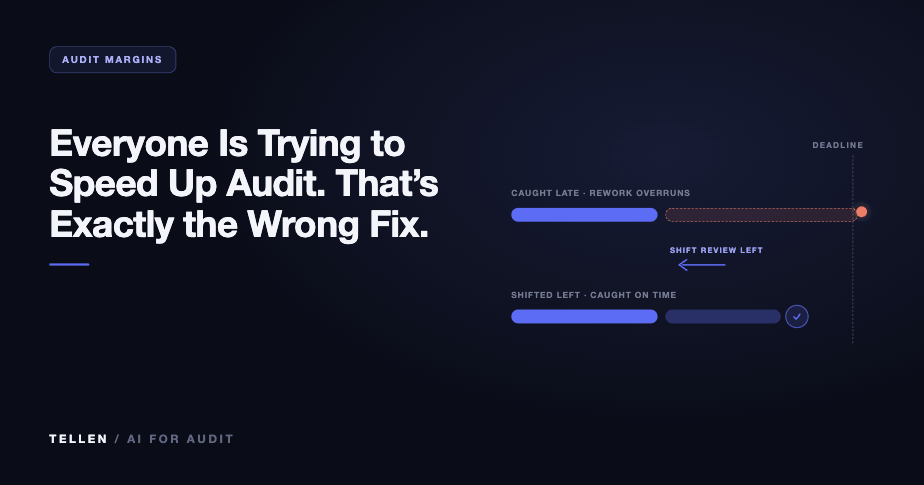
Everyone Is Trying to Speed Up Audit. That's Exactly the Wrong Fix.

Every conversation about margin in audit turns into a conversation about AI. Draft the memo faster, tie out the schedule faster, summarize the contract in seconds. That pitch works because execution is where the hours are, and hours are what you bill against the budget. But execution is rarely what blows up an engagement. I ran plenty of them, and the budget almost never died because fieldwork went a few hours long. It died when the partner sent the file back three weeks later and part of it had to be redone. The costly problem in an audit is the time between finishing a piece of work and finding out something was wrong with it. Most firms skip past that and go shopping for a copilot. I spent a long time on that side of the file, and I still hear the same thing from the partners I talk to now. It hasn't gotten better. In a lot of firms it's gotten worse.
The Industry Was Already on Thin Ice Before AI Showed Up
The margin problem in audit didn't start with AI. It's been compounding for decades. In 1989, there were eight dominant global audit firms. By 2002, after the collapse of Arthur Andersen in the wake of Enron, there were four. Sarbanes-Oxley landed that same year, and with it came PCAOB oversight, mandatory partner rotation, expanded documentation standards, and a compliance infrastructure that required real scale to sustain.
Since then, the trend has only continued downward. The number of firms registered to audit public companies has fallen by more than 40 percent over the past two decades. The firms still standing have absorbed the regulatory burden, but they haven't been able to pass it on. Fee pressure from clients, increasingly commoditized audit work, and fixed headcount costs have kept margins razor-thin. The average audit firm doesn't run at anything close to the margins you'd expect for a professional services business carrying this level of liability.
The result is an industry that has been quietly squeezed from both ends for thirty years, more compliance overhead, flatter fees and that dynamic is exactly why AI is getting so much attention right now. Everyone is looking for the lever that finally moves the math.
The problem is most of them are pulling the wrong one.
Where the Hours Are Hiding (It's Not Where You Think)
Take a typical engagement and the hours fall into a familiar split. Planning runs first—scoping the risk, setting the strategy, staffing the file. About half the budget goes to execution. Then review, which gets a quarter. The exact mix moves with the size and risk of the client, but the shape holds.
The quarter that decides whether you make budget is review, and it doesn't sit evenly across the calendar. It gets squeezed into whatever time is left before the deadline, and it runs against work that was finished weeks earlier. That gap, between when the work got done and when someone senior looked hard at it, is where the margin goes.
Your Team Is Probably Doing the Same Work Twice
Every reviewer knows this sequence. A senior finishes a section. It sits. Two or three weeks later a manager opens it, finds a gap in the documentation, and sends it back. By then the senior is on another job, the client contact who could explain the number has stopped replying, and nobody remembers why the call was made the way it was.
That's not a competence problem. It's what happens to context when the feedback loop runs in weeks instead of hours. The work was fine, or close to it, when it was fresh. By the time someone senior enough to catch the issue gets to it, the person who could have fixed it in a line has moved on and lost the thread.
Usually, that costs a few hours of re-explaining and re-tracing. Sometimes it costs a lot more. If the conclusion was actually wrong, and not just thin on support, no email saves it. You pull the evidence again. You go back to the client on something they thought was closed a month ago. You rebuild the section. That's the job done twice, on the clock, after you already spent the budget once.
Now run that across every section in a file, and every file in a busy season. That's the difference between a book of business that makes money and one that runs flat while everyone works longer hours.
The Audit Industry's Best-Kept Secret: Speed Was Never the Problem
The instinct is to speed up execution and buy more runway before the deadline. It helps a little. It does almost nothing about the thing that actually costs you, which is the distance between doing the work and catching the problem.
The cheapest defect is the one you catch the day it's made.
A documentation gap caught the same afternoon is a one-line fix. The same gap found three weeks later, after the file has moved on and everyone's context is gone, is a re-investigation. It's the same defect. The only thing that changed is what it costs to fix, because every week that passes is another week of context you have to pay to rebuild.
None of this is new. Every field built on review cycles already knows a defect gets cheaper to fix the earlier you find it. Manufacturing worked it out decades ago. Software did too. Audit has just never had a good way to act on it, because review has always meant a person reading a finished file days or weeks after the work was done.
Why Most Firms Are About to Make the Margin Problem Worse
Talk to enough firm leaders and you hear the same worry under the AI enthusiasm. They're about to pour speed into a process that was never short on speed. More first drafts, produced faster, all landing in the same review capacity on the same multi-week cycle. That doesn't shorten the timeline. It moves the same jam earlier.
The firms that gain on margin over the next few years won't be the ones producing the most drafts. They'll be the ones that shorten the distance between when a problem is created and when it's caught, so the three-week-old question never comes up. Catch the documentation gap, the thin conclusion, the missed methodology step while the work is being done and the preparer still has the reasoning in front of them, and it's a one-line fix instead of a rework cycle.
That's where the technology conversation should start. My CTO, Paul Gerlich, picks it up in Part 2: what it takes to close the distance, and why so much of what's being sold to firms right now is aimed at the wrong half of the job.
Part 2 coming soon!